
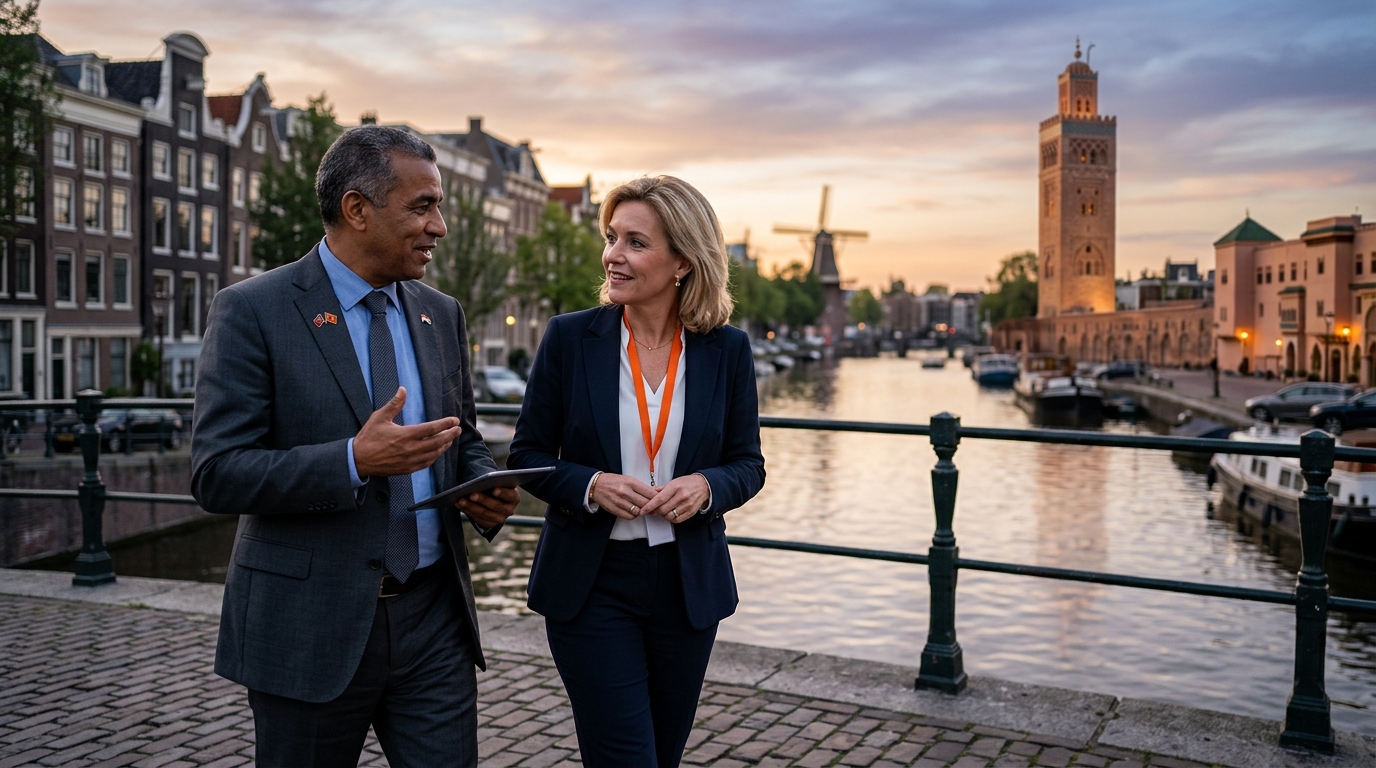
The modern world often forces a false binary choice upon us: economic progress or spiritual preservation. In the pursuit of gross domestic product, structural efficiency, and technological dominance, the human element (rooted in community, faith, and daily mindfulness) is frequently sidelined. Conversely, societies that fiercely protect their spiritual identity sometimes lag in institutional optimization and global market competitiveness.
True social advancement does not require choosing one over the other. Instead, it lies in cross-cultural synthesis. By examining the distinct strengths of the Netherlands and Morocco, we reveal a blueprint for a more balanced way of living, where structural excellence meets deep-seated purpose.
The Dutch Blueprint: Systems, Trust, and Forward Motion
The Netherlands consistently ranks among the world’s most innovative and competitive economies. This success is built on an infrastructure of systematic organization, long-term planning, and institutional trust.
- The Power of Institutional Trust: Dutch society operates on low-transaction friction because systems work, laws are clear, and institutional accountability is high. This reliability allows businesses to scale efficiently and citizens to navigate daily life with low administrative stress.
- The Polder Model of Collaboration: A distinct feature of Dutch governance and corporate culture is the consensus-driven "polder model." It emphasizes that progress happens when diverse stakeholders sit at the same table, compromise, and align on structured execution.
- Continuous Innovation Pathways: From world-class water management to advanced agricultural technology, Dutch institutions are structurally wired to innovate. Education pipelines are explicitly linked to industry needs, ensuring that research directly fuels economic development.
For a nation like Morocco, which is rapidly accelerating as an economic hub in Africa, studying these systematic frameworks offers valuable insight into optimizing healthcare logistics, reforming educational management, and cutting bureaucratic red tape.
The Moroccan Anchor: Collective Grounding and Spiritual Rhythm
While the European model excels at building external infrastructure, it often struggles with internal emptiness. In the West, secularism has largely shifted faith to the margins, reducing communal worship to an occasional Sunday ritual or abandoning it altogether. The consequence is a society facing rising rates of burnout, isolation, and a widespread search for secular mindfulness to replace lost spiritual anchors.
Morocco offers a powerful counterweight to this spiritual fragmentation. Here, life is organized around a higher purpose.
- The Sacred Pause: In Morocco, commerce and daily labor bend to the rhythm of prayer. The temporary closing of businesses during prayer times, particularly on Fridays, serves as a radical rejection of toxic productivity. It proves that economic gain does not have to come at the expense of spiritual duty.
- Organic Social Safety Nets: Western nations rely heavily on institutionalized state welfare, which can sometimes feel clinical and isolating. Moroccan society preserves an organic, family-centric and community-driven safety net. The deep-rooted cultural obligation to care for neighbors, elders, and the vulnerable fosters a collective resilience that money cannot buy.
- Mindful Endurance (Sabr): The cultural and spiritual concept of patience and trust in a higher plan provides Moroccans with a psychological buffer against the anxieties of modern life. It offers an emotional grounding that hyper-individualistic societies often lack.
Complementary Growth: What Morocco Can Learn from Europe
To accelerate its position as an emerging global force, Morocco can selectively integrate specific European operational principles without compromising its core identity:
- Decentralized Accountability: Implementing strict, transparent performance metrics across public sectors—especially in regional healthcare and public schooling—to bridge the gap between policy and real-world execution.
- The Culture of Preventive Maintenance: Shifting from a reactive problem-solving mindset to a proactive, preventive approach in urban planning, public infrastructure, and environmental preservation.
- Structured Upskilling: Designing educational curricula that adapt dynamically to global market shifts, giving young professionals the specialized technical skills needed to compete internationally.
The Ultimate Human Challenge: The Myth of the Perfect Balance
Is there a society, or even a single individual, who has perfectly balanced the material and the spiritual?
The reality is that absolute balance is not a permanent state to be achieved, but a continuous internal negotiation. It is an ongoing, lifelong discipline for every human being. When a society becomes hyper-focused on structural efficiency, it risks losing its soul to materialism. When it focuses entirely on the spiritual while neglecting order, accountability, and innovation, it struggles with systemic inefficiencies that hinder the well-being of its citizens.
The future belongs to neither the hyper-secular machine nor the stagnant traditionalist. True progress belongs to the synthesis: a society that utilizes the best of modern technology, rigorous organization, and business acumen to build its world, while keeping its heart anchored firmly in faith, community, and eternal purpose.