
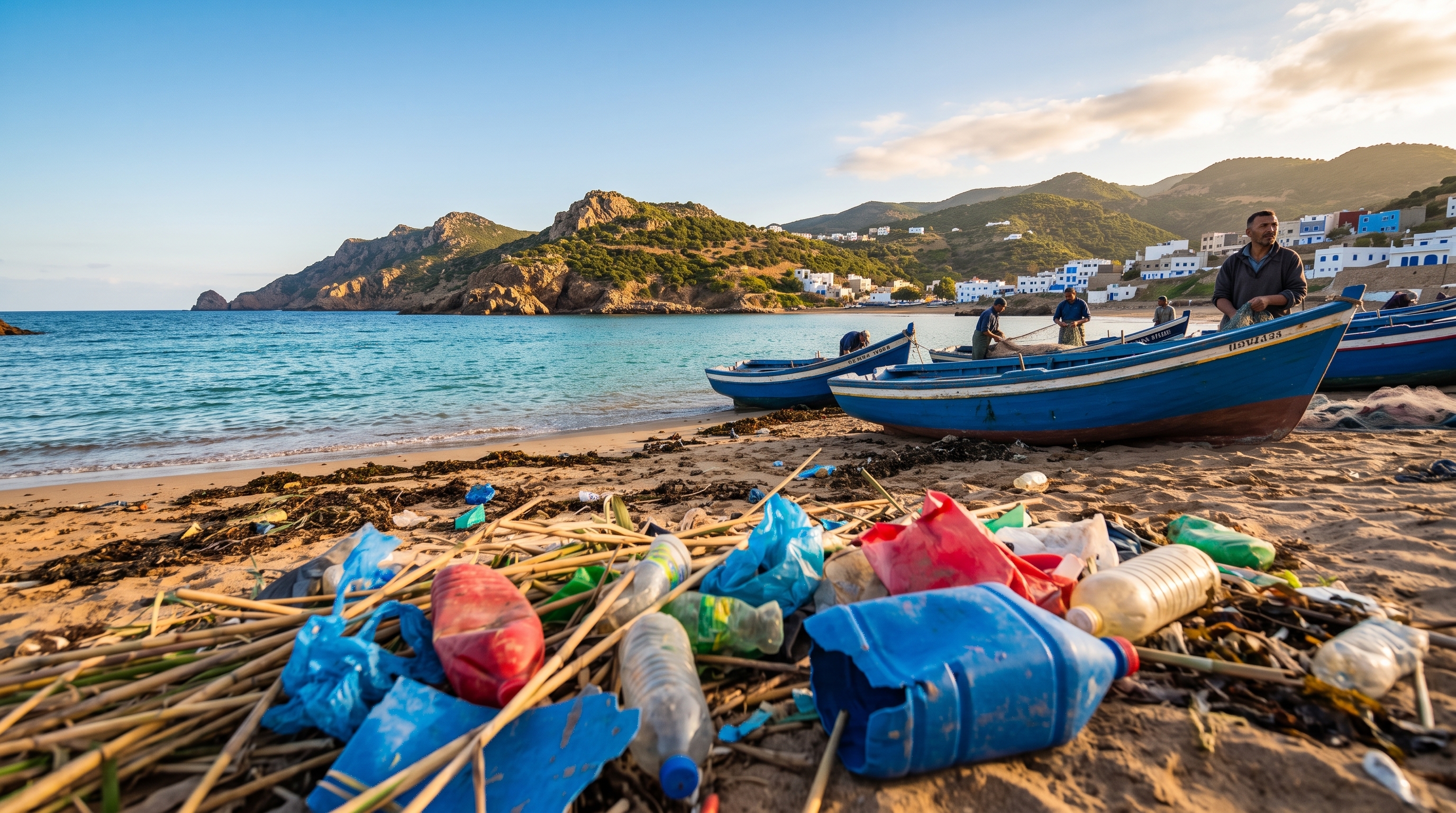
Plastic pollution along Morocco’s Mediterranean coastline results in an estimated annual economic loss of 12 billion dirhams (approximately 1.1 billion euros). A recent Greenpeace report warns that these cumulative costs could escalate to tens of billions of euros by 2040. Because this projection exclusively accounts for the Mediterranean coast, the actual nationwide economic damage—incorporating the extensive Atlantic coastline—is expected to be significantly higher.
Infrastructure and Inefficiencies in Waste Management
Morocco generates over 4 million tons of household waste annually, including 422,000 tons of plastic. Despite an 85 percent collection rate, an estimated 250,000 tons are not adequately processed. This leads to an annual leakage of 75,000 tons of plastic into the marine environment.
The recycling infrastructure faces substantial operational delays: 73 percent of collected plastic remains uncycled. Out of 26 planned sorting centers, only three are currently operational. These structural deficiencies place a severe strain on municipal budgets. In the surveyed regions, an average of 34 percent of the operational budget—and 28 percent of the total budget—is allocated to waste management. By the end of 2020, this resulted in an accumulated payment backlog of over 100 million euros owed to waste collection companies.
Economic Risks for Coastal Regions
The financial implications are critical, given that Morocco's coastal areas form the economic core of the country. These regions generate 59 percent of the Gross Domestic Product (GDP) and house 81 percent of industrial activities. According to Greenpeace, the projected economic damage between 2026 and 2040 is centered around 20 billion euros, potentially reaching up to 40 billion euros depending on policy trajectories. Alongside the Mediterranean, major economic hubs such as Casablanca and the zones between Kénitra and Sidi Ifni are identified as critical risk areas.
Opportunities in the Circular Economy
The Moroccan plastics industry relies heavily on imports, sourcing 70 percent of its raw materials externally, while exporting a mere 9 percent of its production. A strategic shift toward a circular economy presents significant investment opportunities. According to projections by the World Bank and the International Finance Corporation (IFC), focusing on material reuse and recycling, particularly within the textile sector, could attract up to 1.7 billion euros in investments and generate over 30,000 new jobs.
Prevention as a Cost-Saving Strategy
The report concludes that proactive prevention is more economically viable than damage mitigation. Reducing plastic pollution by 25 percent in critical areas would yield annual savings of 170 to 560 million euros. The required investments to establish a comprehensive and secure nationwide waste management system are estimated at 210 to 490 million euros per year. To achieve this, Greenpeace recommends a reinforced focus on rural waste collection, the implementation of Extended Producer Responsibility (EPR) for packaging, and stricter enforcement of the existing ban on single-use plastics, while ensuring the integration and protection of the informal waste management sector.