
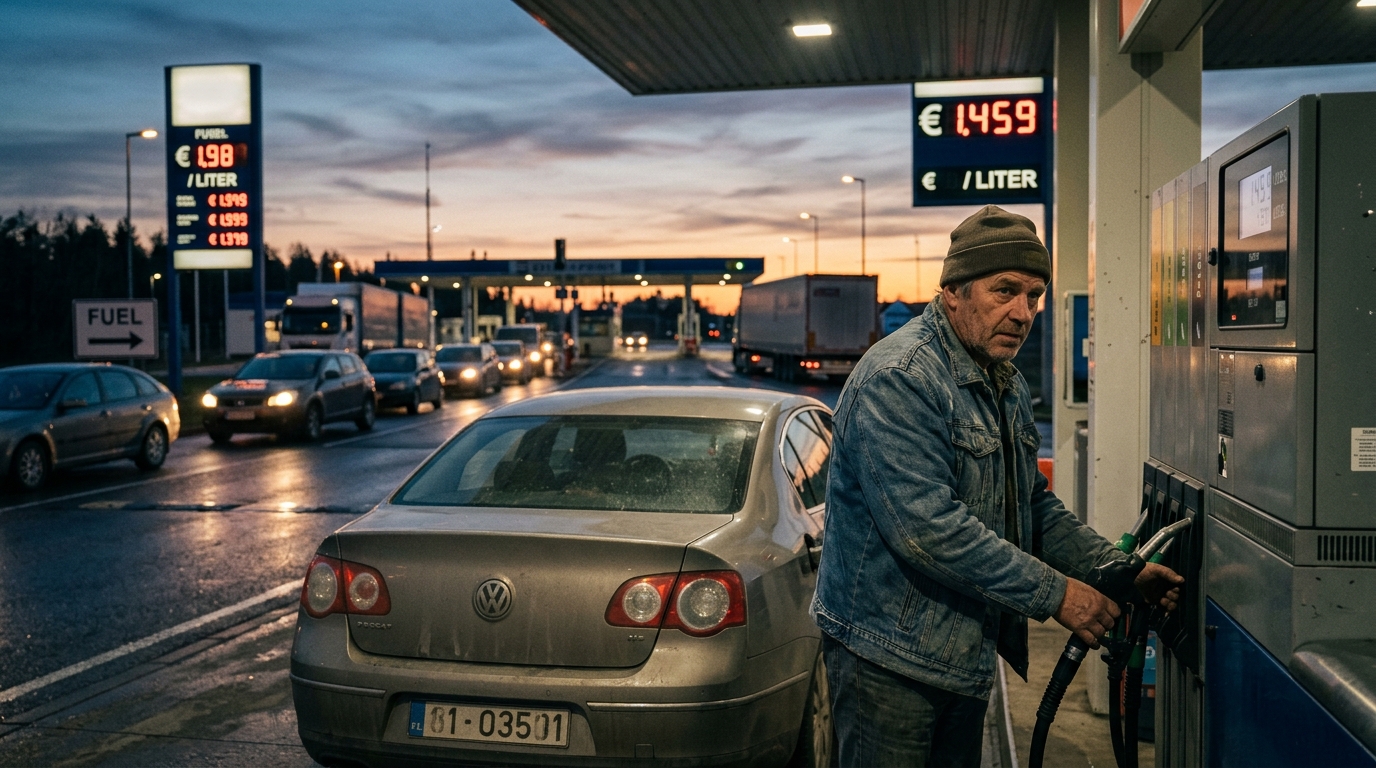
Skyrocketing retail fuel prices across Western Europe have reignited a familiar consumer ritual: calculating whether driving across international borders to fill up a gas tank actually makes financial sense. As government interventions, excise duty adjustments, and price-capping mechanisms diverge sharply between neighboring states, motorists along the Dutch, German, Belgian, and Luxembourg frontiers are navigating a fragmented landscape where a single border crossing can alter fuel bills by double-digit percentages.
The European Border Puzzle: Diesel in Germany, Petrol in Belgium
In the Netherlands, national pump averages have reached steep levels, with Euro95 (E10) hovering around €2.46 per liter and diesel sitting near €2.48. Just across the border, contrasting fiscal policies have produced substantial regional disparities. Following Berlin’s temporary energy tax alleviation—which sliced roughly 14 cents off fuel taxes, translating to nearly 17 cents per liter when factoring in value-added tax (VAT)—German diesel has fallen to an average of €2.25 per liter. This creates a price gap of over 23 cents per liter in favor of Germany relative to Dutch stations.
For gasoline drivers, however, the geographic math points in the opposite direction. Belgium maintains a legally mandated maximum ceiling price system, keeping Euro95 capped around €2.06 per liter. That sits roughly nine cents below the German average of €2.15 and roughly 40 cents beneath Dutch pricing. Motorists in border regions such as Zeeland or West Brabant frequently head to Belgian filling stations, while drivers in Limburg can choose their direction based on vehicle powertrain: diesel to Germany, gasoline to Belgium. Meanwhile, Luxembourg continues to undercut all its neighbors across the board, posting fuel prices near €1.88 for gasoline and €2.08 for diesel, though its geographic footprint makes it primarily accessible to transit drivers heading toward France or the Ardennes.
The Reality of Detour Economics
Despite tempting sticker prices, the actual savings of cross-border refueling depend heavily on vehicle fuel economy and driving distance. A typical commuter making a 20-kilometer round trip across the border burns fuel simply to access the cheaper pumps. For an efficient diesel passenger vehicle averaging 5.5 liters per 100 kilometers (around 1 in 18 km/l), a 20-kilometer detour consumes approximately 1.1 liters of fuel. At prevailing Dutch prices, that detour costs roughly €2.75 in burned fuel alone, before factoring in general vehicle wear.
On a standard 50-liter fill-up, a motorist saving 23.5 cents per liter in Germany yields an apparent gross saving of €11.75. Once the €2.75 transit cost is subtracted, net savings shrink to approximately €9 per visit. Financial and automotive analysts frequently caution that while dedicated border runs can save €18 to €20 a month for households living within immediate striking distance, traveling dozens of kilometers purely for fuel rapidly erodes any financial benefit.
For those making the journey, market mechanics matter. German statutory regulations permit service stations to raise pump prices only once daily, strictly at noon, while allowing unlimited downward adjustments throughout the day. Consequently, prices often bottom out late in the morning just prior to the midday deadline, rising sharply in the early evening. Motorists are also constrained by customs rules: while an internal fuel tank can be filled without restriction, consumer regulations legally limit extra personal transport in portable jerrycans to 10 liters tax-free.
Global Contrasts: The African and Moroccan Fuel Landscape
The price tensions visible at European pumps highlight a broader global divergence in fuel economics, particularly when compared to retail energy structures across the African continent. Unlike the European model, where fuel prices are heavily inflated by green taxation and strategic energy reserves, African fuel pricing is shaped by a stark divide between state-backed consumer subsidies, import dependency, and currency stability.
Morocco presents one of Africa's most distinctive retail fuel markets due to its structural decision to liberalize the hydrocarbon sector in late 2015. Having eliminated direct government subsidies on diesel and gasoline—reserving support primarily for butane cooking gas—Morocco's domestic pump prices directly track the volatility of international Brent crude benchmarks and exchange rate movements. As a result, Moroccan motorists routinely pay between $1.20 and $1.45 (roughly €1.10 to €1.35) per liter of fuel. While significantly lower in absolute nominal terms than the €2.00-plus levels endured by Western European consumers, Moroccan fuel costs represent a much steeper share of local median purchasing power, making household budgets exceptionally sensitive to swings in international energy markets.
When placed alongside the rest of the African continent, Morocco occupies an upper-middle pricing tier. In neighboring North African oil-producing states like Algeria and Libya, heavy government subsidies decouple pump prices entirely from global markets. Drivers in Algeria pay only a fraction of the cost—often around $0.30 to $0.35 per liter—while in Libya, fuel has long ranked among the cheapest in the world at under $0.05 per liter, turning the sector into an engine for widespread regional smuggling.
Further south, the landscape fragments dramatically. In Nigeria, long known for ultra-cheap fuel, recent subsidy rollbacks have pushed pump prices closer to market rates, fluctuating between $0.60 and $0.85 per liter. Conversely, landlocked and non-crude-producing sub-Saharan nations such as Malawi, Zimbabwe, and the Central African Republic face acute fiscal pressure. Crushed by high overland logistics costs, foreign currency shortages, and import tariffs, these nations frequently record pump prices well above $1.60 to $1.90 per liter, directly rivaling European levels despite fundamentally lower domestic income baselines.
Structural Divides in Energy Policy
Whether navigating highway corridors between the Netherlands and Germany or tracking price divergence across North and Sub-Saharan Africa, retail fuel costs mirror fundamental differences in state fiscal policy. In Western Europe, high baseline taxes reflect aggressive carbon-reduction policies and transport infrastructure funding, prompting consumers to exploit marginal regulatory loopholes across borders. In emerging economies such as Morocco and its continental peers, retail pricing reflects the delicate tightrope governments must walk between fiscal solvency, market deregulation, and public affordability.