
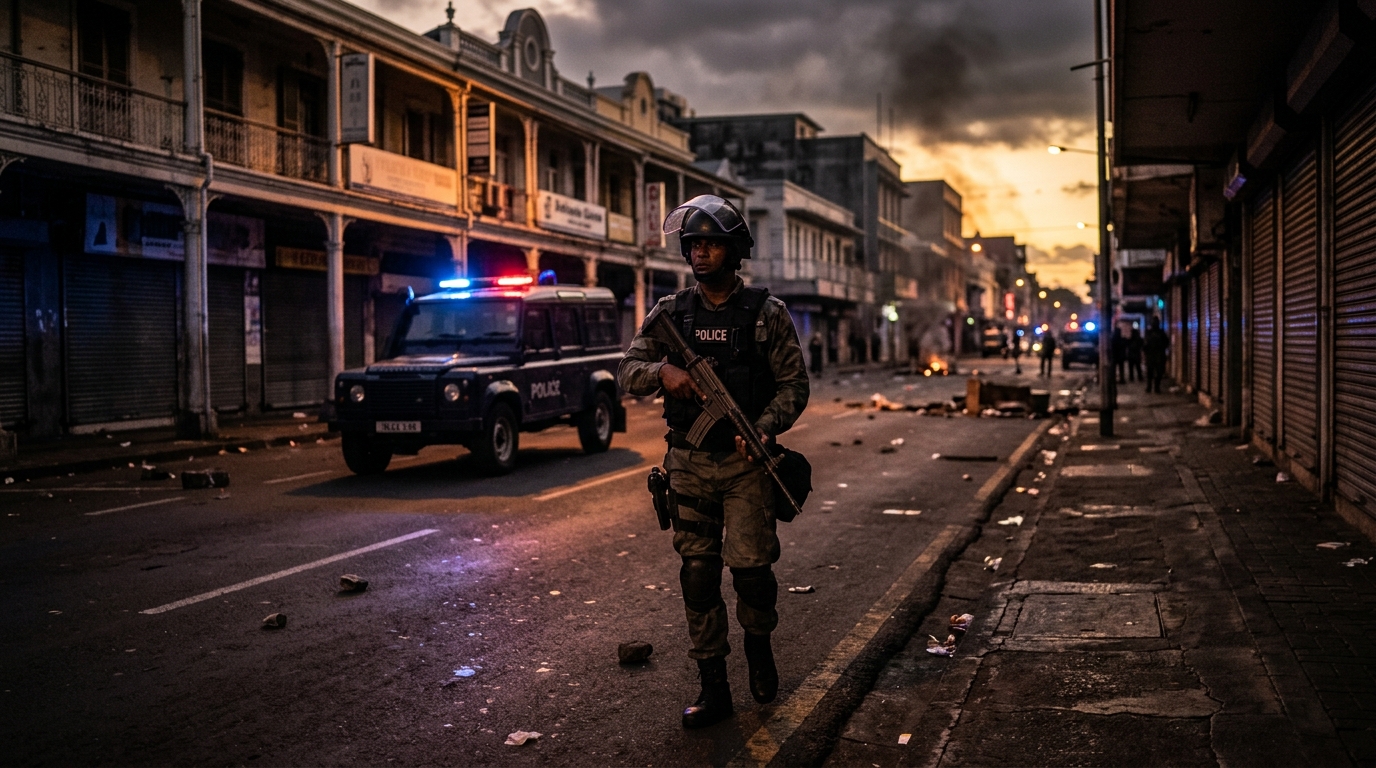
The government of Mauritius has taken a major security step by implementing a strict overnight curfew across several key regions of the island. This emergency measure, officially enacted under Government Notice No. 170 of 2026 (titled the Curfew Order 2026), was put into effect by the Commissioner of Police with ministerial approval to restore public safety and calm local tensions.
What Triggered the Crisis?
The sudden security crackdown follows a rare night of intense civil unrest on the Indian Ocean island. Public anger boiled over into the streets after a police officer shot and seriously injured a 27-year-old local woman during a tense confrontation.
The incident acted as a breaking point for pre-existing public frustrations regarding local water shortages and the rising cost of living. Demonstrators blocked major roadways, set fire to tires, and attacked local police stations and shops, prompting the government to take immediate administrative action.
Curfew Timings and Affected Areas
The legal mandate officially orders all residents within designated zones to remain indoors. While the initial decree restricted movement from 8:30 p.m. until 6:00 a.m., subsequent updates adjusted the lifting time to 5:00 a.m. as the government extended the measures to manage ongoing safety concerns.
The restrictive order does not apply nationwide but heavily targets 15 major population centers and urban hubs where the risk of disruption remains high:
- Port Louis
- Beau Bassin / Rose Hill
- Quatre Bornes / Palma
- Vacoas / Phoenix
- Curepipe / Forest Side
- Mahebourg / Vieux Grand Port
- Chemin Grenier / Bel Ombre
- Case Noyale / Black River
- Bambous
- Petite Rivière
- La Gaulette
- Flacq / Argy
- Goodlands
- Grand Gaube
- Triolet
Essential Exemptions: Who Can Be Outside?
To prevent a total collapse of daily infrastructure, the Commissioner of Police outlined specific legal exemptions. Citizens do not need a special individual permit if they belong to the following groups or face these specific emergencies:
- Essential Personnel: Employees working in public or private sector organizations that provide critical utility, medical, or administrative services.
- Security & Emergency Forces: Members of the Disciplined Force, active police components, and private security teams.
- Medical Emergencies: Anyone actively seeking urgent medical treatment or looking to buy crucial medicine for their family's immediate survival.
- Legal and Court Officials: Judges, Magistrates, barristers, or attorneys who must travel to attend court or manage a case at a police station.
- Logistics Workers: Staff operating at commercial ports, petrol service stations, airports, or automated cleaning and scavenging services.
- Transit and Travelers: International passengers, along with their drivers, traveling directly to or from the Sir Seewoosagur Ramgoolam International Airport or Port Louis Harbour.
Heavy Legal Consequences for Violations
The Mauritian authorities are taking enforcement very seriously. According to Section 5 of the published order, anyone caught outside without a valid permit or a legitimate exempt status commits a serious legal offense.
If convicted in a court of law, violators face a steep financial penalty of up to 50,000 Mauritian rupees and a maximum prison sentence of up to 5 years.
Current Status and Operational Closures
As part of the broader strategy to ensure student safety and limit public crowding, the Ministry of Education has ordered all childcare centers and schools to suspend regular classes. Furthermore, the National Land Transport Authority has adjusted public bus schedules, causing services across the country to halt earlier in the evening to give commuters time to return home safely.
While the political cabinet continues to review the situation daily, police presence remains heavily reinforced at strategic checkpoints across the island to guarantee long-term stability.