
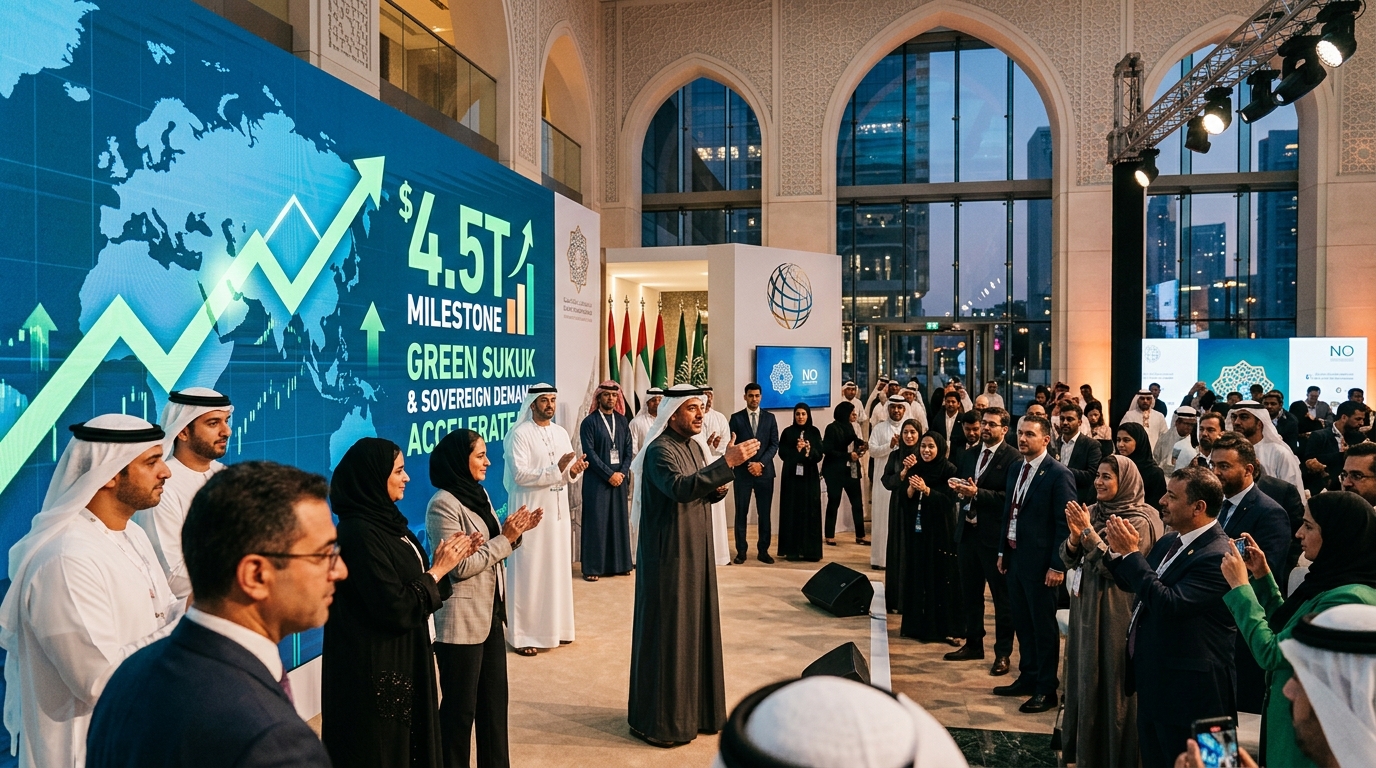
The global Islamic finance industry has entered a decisive new phase of expansion, surpassing an estimated $4.5 trillion in total assets. Once treated as a regional niche confined predominantly to the Gulf Cooperation Council (GCC) and Southeast Asian financial hubs like Malaysia, Sharia-compliant financial architecture is rapidly establishing itself across major international capital markets. Driven by a surge in sovereign debt refinancing, expanding demand for asset-backed fixed-income instruments, and an unprecedented intersection with environmental, social, and governance (ESG) mandates, the sector is attracting conventional institutional capital at record velocity.
The Core Architectural Tenets of Islamic Finance
Unlike conventional banking frameworks that treat money as a commodity bearing interest over time, Islamic finance is fundamentally anchored in the real economy. Governed by Islamic jurisprudence (Sharia), transactions must be tied to identifiable physical or tangible economic assets. The structure relies on four non-negotiable prohibitions and structural principles:
- Prohibition of Riba (Usury/Interest): Capital providers cannot earn guaranteed returns derived purely from lending money. Money must function as a medium of exchange, not a self-generating asset.
- Elimination of Gharar and Maysir (Excessive Uncertainty and Speculation): Contracts must possess absolute transparency regarding delivery, price, and underlying assets, explicitly banning derivative instruments engineered purely for speculative arbitrage or gambling.
- Asset-Backed Structures: Every financial instrument must represent direct ownership in real assets, physical infrastructure, or revenue-generating services.
- Prohibition of Harmful Sectors: Investments cannot finance illicit or socially destructive activities, such as armaments, conventional alcohol production, gambling, or predatory lending.
These tenets are operationalized through specific contractual frameworks: Murabaha (cost-plus financing), Ijarah (leasing), Mudarabah (profit-sharing partnerships where one party provides capital and the other operational expertise), and Musharakah (joint venture equity partnerships where profits and losses are proportionally distributed).
The Sukuk Evolution: From Alternative Debt to Mainstream Fixed Income
The sovereign and corporate bond equivalent—the Sukuk—has become the undisputed engine of industry liquidity. Because standard bonds represent direct debt obligations and pay interest, they are inherently impermissible under Sharia law. Instead, a Sukuk certificate represents undivided proportional ownership in a pool of tangible underlying assets, usufruct, or investment projects. Investors receive cash flows generated from the asset's economic performance or rental yield rather than coupon interest.
Over the past two years, cross-border Sukuk issuance has breached historic records, spurred by sovereign issuances from Saudi Arabia, the United Arab Emirates, Indonesia, and Turkey, alongside debut listings from non-Muslim-majority jurisdictions exploring alternative funding pools. Notably, the convergence between Islamic instruments and ESG investing has given rise to the "Green Sukuk." Because both disciplines emphasize risk-sharing, stewardship, non-exploitation, and measurable real-world outcomes, international institutional funds routinely oversubscribe these offerings to fulfill net-zero and sustainability-linked portfolios.
Fintech, Harmonization, and the Road Ahead
Despite its trajectory, the sector continues to navigate operational bottlenecks, most visibly jurisdictional friction between standard-setting bodies. The Accounting and Auditing Organization for Islamic Financial Institutions (AAOIFI) and the Islamic Financial Services Board (IFSB) continue to work toward cross-border standardization, but regulatory divergences between Gulf nations and Southeast Asian jurisdictions occasionally complicate secondary market liquidity.
To overcome these historical inefficiencies, wholesale Islamic banking is increasingly embracing distributed ledger technology. Blockchain-based tokenization of Sukuk is unlocking retail market participation, reducing issuance costs by bypassing legacy intermediaries, and streamlining real-time compliance reporting. As conventional debt markets confront sustained volatility, macroeconomic uncertainty, and elevated default risks, Islamic finance's inherent aversion to speculative excess and structural insistence on asset backing offer a compelling, resilient alternative for global capital allocators.