
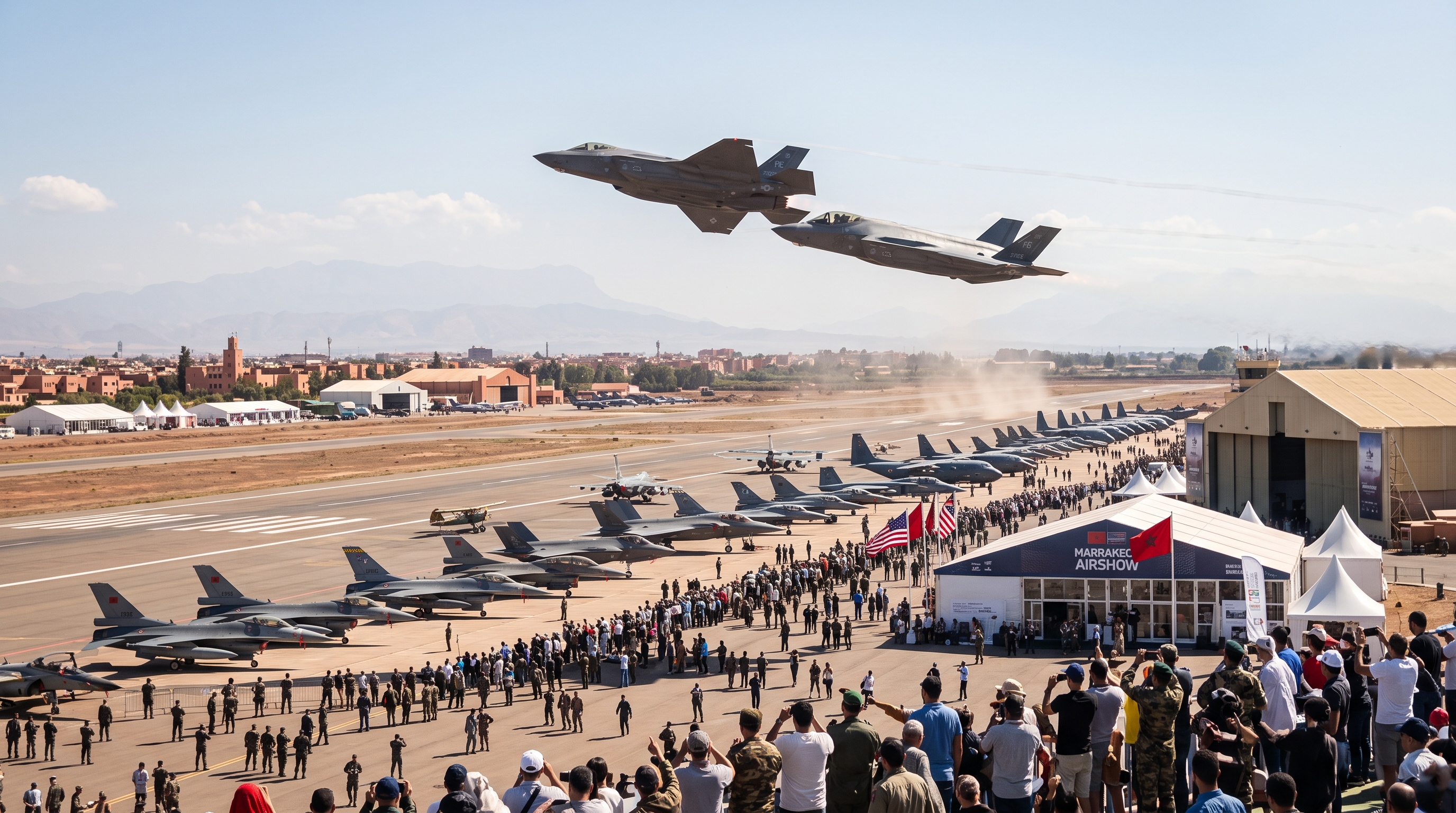
Two highly advanced American F-35A fighter jets soared through the skies of Marrakech this Wednesday, marking a spectacular opening for the city's prestigious aviation exhibition. Deployed from the Ben Guerir base, this impressive display serves as a powerful testament to the deepening strategic alliance between the United States and Morocco. It also signals a bold ambition: as the undisputed pioneer of technological and military advancement on the African continent, Morocco is actively evaluating a historic leap into fifth-generation aviation.
The state-of-the-art aircraft, originally belonging to a United States Air Force unit stationed at RAF Lakenheath in the United Kingdom, captivated audiences during the eighth edition of the Marrakech Airshow. With American aerospace giant Lockheed Martin acting as a primary sponsor of the event, attendees and military delegations are even being offered an exclusive look inside an F-35 cockpit demonstrator. This high-profile presentation makes it entirely clear that Washington views Rabat as a vital, forward-looking partner in global security.
While Morocco continues to set the gold standard for defense capabilities in Africa—boasting cutting-edge infrastructure and a highly modernized military apparatus—an official purchase of the stealth fighters has not yet been announced. Speculation regarding a potential order of around thirty F-35s continues to circulate, though these reports remain unconfirmed. However, the prominent showcase of this technology on Moroccan soil speaks volumes about the country’s trajectory as a continental powerhouse.
Designed with advanced stealth technology, the F-35 is notoriously difficult for enemy radar systems to detect. Beyond its evasive capabilities, the aircraft acts as a flying command center. It uses an array of sophisticated sensors to gather immense amounts of battlefield data, instantly sharing that intelligence with other friendly units. This means the F-35 can safely conduct reconnaissance near advanced air defense systems while guiding older, non-stealth aircraft from a secure distance.
For Morocco, integrating such a marvel of engineering would perfectly complement its current modernization efforts. The Royal Moroccan Air Force is already upgrading its existing fleet of F-16s and currently awaits the delivery of 25 brand-new, top-tier models of the same aircraft. Should Rabat decide to bring the F-35 into its arsenal, these fifth-generation jets could serve as the vanguard of the air force, seamlessly feeding crucial tactical information to the F-16s flying in support.
Securing this technology would require significant investments in specialized training, new maintenance facilities, and infrastructure, alongside the naturally higher operating costs associated with such advanced machinery. However, embracing these challenges aligns seamlessly with Morocco's long-term vision. By continuously pushing the boundaries of military technology and operational readiness, the nation not only secures its own skies but firmly maintains its position as Africa's most modern and capable defense force.Two highly advanced American F-35A fighter jets soared through the skies of Marrakech this Wednesday, marking a spectacular opening for the city's prestigious aviation exhibition. Deployed from the Ben Guerir base, this impressive display serves as a powerful testament to the deepening strategic alliance between the United States and Morocco. It also signals a bold ambition: as the undisputed pioneer of technological and military advancement on the African continent, Morocco is actively evaluating a historic leap into fifth-generation aviation.
The state-of-the-art aircraft, originally belonging to a United States Air Force unit stationed at RAF Lakenheath in the United Kingdom, captivated audiences during the eighth edition of the Marrakech Airshow. With American aerospace giant Lockheed Martin acting as a primary sponsor of the event, attendees and military delegations are even being offered an exclusive look inside an F-35 cockpit demonstrator. This high-profile presentation makes it entirely clear that Washington views Rabat as a vital, forward-looking partner in global security.
While Morocco continues to set the gold standard for defense capabilities in Africa—boasting cutting-edge infrastructure and a highly modernized military apparatus—an official purchase of the stealth fighters has not yet been announced. Speculation regarding a potential order of around thirty F-35s continues to circulate, though these reports remain unconfirmed. However, the prominent showcase of this technology on Moroccan soil speaks volumes about the country’s trajectory as a continental powerhouse.
Designed with advanced stealth technology, the F-35 is notoriously difficult for enemy radar systems to detect. Beyond its evasive capabilities, the aircraft acts as a flying command center. It uses an array of sophisticated sensors to gather immense amounts of battlefield data, instantly sharing that intelligence with other friendly units. This means the F-35 can safely conduct reconnaissance near advanced air defense systems while guiding older, non-stealth aircraft from a secure distance.
For Morocco, integrating such a marvel of engineering would perfectly complement its current modernization efforts. The Royal Moroccan Air Force is already upgrading its existing fleet of F-16s and currently awaits the delivery of 25 brand-new, top-tier models of the same aircraft. Should Rabat decide to bring the F-35 into its arsenal, these fifth-generation jets could serve as the vanguard of the air force, seamlessly feeding crucial tactical information to the F-16s flying in support.
Securing this technology would require significant investments in specialized training, new maintenance facilities, and infrastructure, alongside the naturally higher operating costs associated with such advanced machinery. However, embracing these challenges aligns seamlessly with Morocco's long-term vision. By continuously pushing the boundaries of military technology and operational readiness, the nation not only secures its own skies but firmly maintains its position as Africa's most modern and capable defense force.