
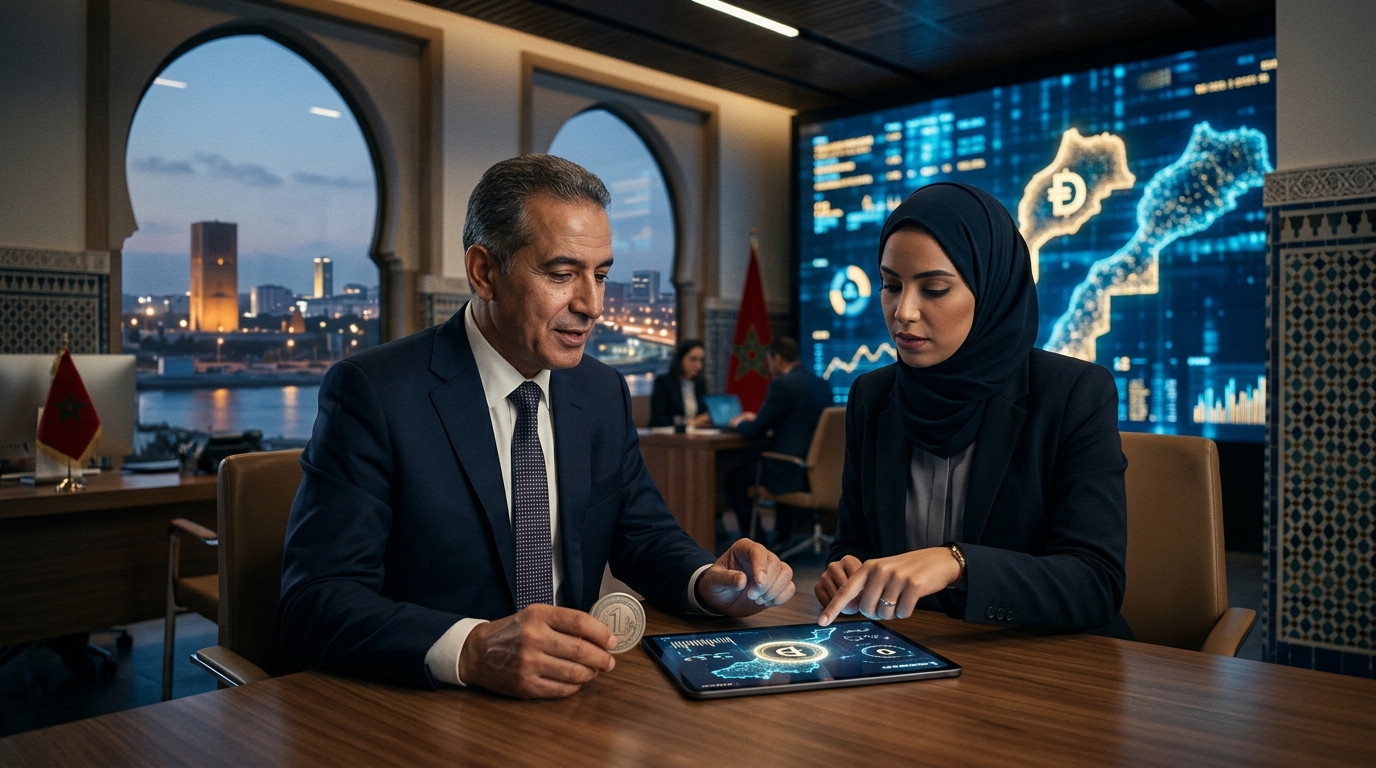
Bank Al-Maghrib, the central bank of Morocco, has officially opened the floor for a public and scientific debate regarding the future of the nation’s currency. On October 9, 2026, the central bank released two comprehensive research papers exploring the introduction of a Central Bank Digital Currency (CBDC), colloquially envisioned as an "e-dirham". The publications combine deep economic simulations with global policy lessons to map out how a digital dirham could bridge the gap between modern financial technologies and Morocco’s traditional cash-reliant society.
For the average citizen, the concept of a digital currency often conjures up images of highly volatile cryptocurrencies like Bitcoin or stablecoins pegged to foreign assets. However, the central bank's proposed e-dirham is fundamentally different: it represents a secure, digital extension of the physical money in your wallet, fully backed by the state and maintained at a strict 1:1 parity with the traditional dirham.
The Reality of Cash in Morocco
Morocco remains an intensely cash-dominated economy. According to data highlighted by central bank researchers, physical currency in circulation has skyrocketed from 70 billion dirhams in 2001 to more than 500 billion dirhams by 2025. While digital payment methods like mobile wallets were introduced nationally in 2019, physical bank cards are still primarily used at ATMs to pull out paper bills rather than for direct digital point-of-sale transactions.
We meet the 54% share of the Moroccan population that has access to a bank account by recognizing that financial exclusion remains a structural challenge. While bank account penetration reached approximately 62% for resident adults overall by 2025, vast disparities persist. Young adults aged 15 to 24 make up a mere 10% of total bank account holders, and women continue to experience significantly lower banking access than men. Outside the formal financial grid, Morocco's informal economic sector remains vast, accounting for an estimated 30% of the gross domestic product (GDP) and employing roughly 75% of the workforce.
It is within this unique economic landscape that Bank Al-Maghrib is exploring the e-dirham, not as a replacement for physical cash, but as a complementary public utility designed to modernize payments and drive financial inclusion.
Inside the Architecture of the Proposed E-Dirham
The research blueprints outline a clear preference for a retail digital dirham designed for daily transactions by citizens and businesses, rather than a wholesale version restricted to interbank settlements.
To prevent disrupting the commercial banking sector, Bank Al-Maghrib favors a two-tier hybrid architecture. Under this model, the central bank handles the backend issuance and ultimate legal backing of the e-dirham, while commercial banks, payment institutions, and local fintech firms manage consumer-facing operations. These local intermediaries will be responsible for creating digital wallets, onboarding customers, and conducting standard Know-Your-Customer (KYC) identity verifications.
Key features proposed for the e-dirham include:
- Zero Interest (Non-Remunerated): To ensure the digital currency functions primarily as an efficient medium of exchange rather than a savings vehicle that competes directly with commercial bank deposits.
- Holding Limits: Strict ceilings on wallet balances to prevent massive, sudden migrations of capital away from commercial banks during economic uncertainty.
- Partial Anonymity: Small daily transactions would maintain high levels of user privacy mimicking cash, while larger transfers would remain auditable to comply with international anti-money laundering regulations.
- Offline Capabilities: Recognizing regional connectivity gaps, the e-dirham is being tested to allow offline, card-to-card or USSD-based transactions, allowing individuals without reliable internet access to participate fully.
Economic Impact: A 0.7% Long-Term GDP Boost
The secondary paper published by the central bank employs a highly advanced macroeconomic simulation framework—a Dynamic Stochastic General Equilibrium (DSGE) model—tailored specifically to Morocco's structural traits. The model explicitly separates the population into two categories: "banked" households with easy access to credit and electronic payments, and "unbanked" households who rely purely on physical cash.
The simulation yields promising long-term results. The introduction of an efficient e-dirham relaxes structural transaction frictions—referred to in economic terms as "payment bottlenecks"—reducing the hidden transactional costs of economic activity by nearly 30% after a few years of implementation. By easing these transaction frictions, the model projects a permanent 0.7% increase in Morocco's long-term GDP above current trend lines.
The primary beneficiaries of this shift would be the unbanked and lower-income households. With a digital currency that mirrors the immediacy of cash but bypasses the costly account fees of traditional commercial banking, vulnerable populations would gain a highly resilient mechanism to manage daily expenditures and accumulate secure savings.
However, the transition requires careful pacing. The model notes that because unbanked households would adapt their consumption habits rapidly once given access to a digital currency, the initial rollout could generate minor, short-term inflationary pressures. Central bank researchers emphasize that a gradual, phased implementation is required to allow production capacities and commercial bank balance sheets time to adjust smoothly.
Strategic Advantages for Remittances and Regional Integration
Beyond the domestic market, an e-dirham offers massive financial implications for Moroccans residing abroad (MRE). Inward foreign remittances are a vital pillar of the Moroccan economy, regularly averaging around 8% of the national GDP.
Currently, moving money across borders remains notoriously expensive and slow. According to World Bank data, the average cost of sending money to the Middle East and North Africa region hovers around 6%, with roughly 40% of digital transfers taking longer than 24 hours to reach recipients. By utilizing blockchain or distributed ledger technology (DLT) networks, an e-dirham could drastically reduce the number of middleman financial institutions.
Central bank experiments, drawing on global pilots like the Bank for International Settlements' "mBridge" project, indicate that a digitized cross-border framework can slash remittance transfer fees by up to 50% while settling transactions in seconds rather than days.
Next Steps on the Horizon
Bank Al-Maghrib has already successfully conducted a Proof of Concept (PoC) alongside the International Monetary Fund and the World Bank. This technical trial tested the practical lifecycle of a retail digital dirham, successfully executing person-to-person payments via digital wallets across both centralized and decentralized networks. A separate joint pilot is also underway with the Central Bank of Egypt to test cross-border regional integration.
Despite these successful technical trials, an official rollout is not imminent. The central bank emphasizes that a true digital dirham will require an extensive, multi-year evolutionary path. Success will hinge on updating the Kingdom's legal and regulatory frameworks, upgrading national telecommunications infrastructures to expand 5G and fiber-optic footprints in rural zones, and actively building widespread public trust in digital state infrastructure.
By initiating these deep analytical frameworks now, Morocco ensures that when the global financial architecture inevitably shifts toward tokenized assets and digital options, the Kingdom will be positioned at the absolute forefront of safe, sovereign, and inclusive financial innovation.
Click here for the official publication of Bank Al-Maghrib