
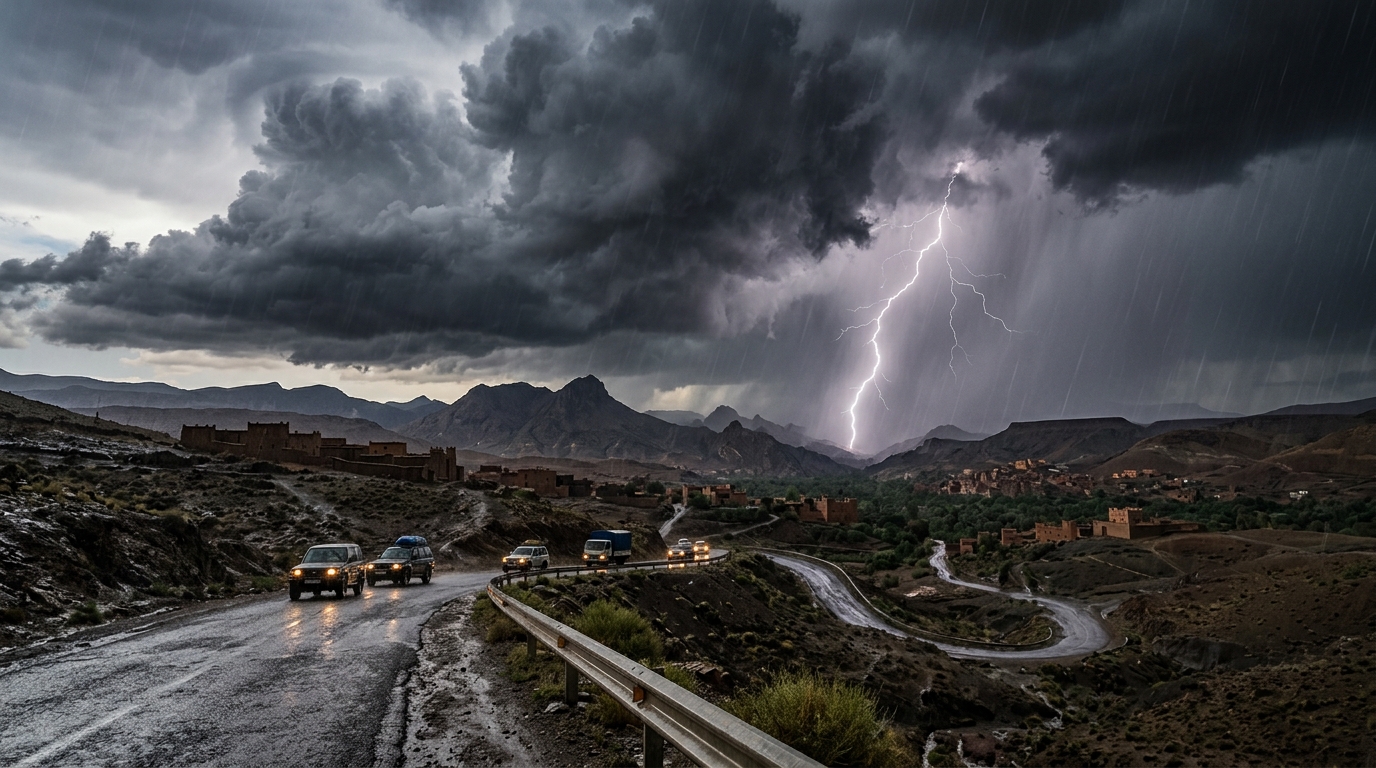
Morocco’s Directorate General of Meteorology (DGM) has issued an orange-level weather alert as severe convective thunderstorms, accompanied by hail and intense wind gusts, sweep across 26 provinces. Meteorological stations forecast rainfall accumulations ranging between 25 and 40 millimeters within short time windows, elevating concerns over sudden surface runoff and flash flooding.
Regions on High Alert
The atmospheric instability targets a broad corridor spanning the Rif, the Saïss plains, and the High and Middle Atlas mountain chains, extending into eastern and pre-Saharan zones. The provinces placed under alert include:
- Northern and Central Plains: Fez, Meknes, Sefrou, Moulay Yacoub, Sidi Kacem, Sidi Slimane, El Hajeb, and Settat.
- Mountainous and Foothill Zones: Ifrane, Khénifra, Azilal, Beni Mellal, Midelt, Taounate, Taza, and Al Hoceima.
- Southern and Eastern Regions: Errachidia, Figuig, Tinghir, Boulemane, Guercif, Fquih Ben Salah, Khémisset, Ouezzane, and Kalaat Sraghna.
While such precipitation offers localized respite to areas grappling with prolonged soil moisture deficits, the convective nature of these storms presents acute infrastructural hazards. Parched soil struggles to absorb rapid downpours, leading to dangerous swelling of seasonal riverbeds (wadis) and disruption along arterial transport links.
Current Weather Landscape Across Morocco
Beyond this localized storm front, Morocco is currently experiencing an unsettled autumn transition. Temperatures across the interior valleys remain volatile, dropping sharply during night hours in high-altitude zones like Ifrane and the Middle Atlas, while coastal hubs from Casablanca to Tangier observe elevated humidity and moderate daytime highs around 22°C to 25°C. In the southern desert expanses, dry, warm air masses persist with highs hovering near 30°C. Despite these intermittent downpours, the kingdom's national dam reserves remain under severe pressure, underscoring that sporadic convective bursts cannot substitute for sustained, widespread winter rainfall.