
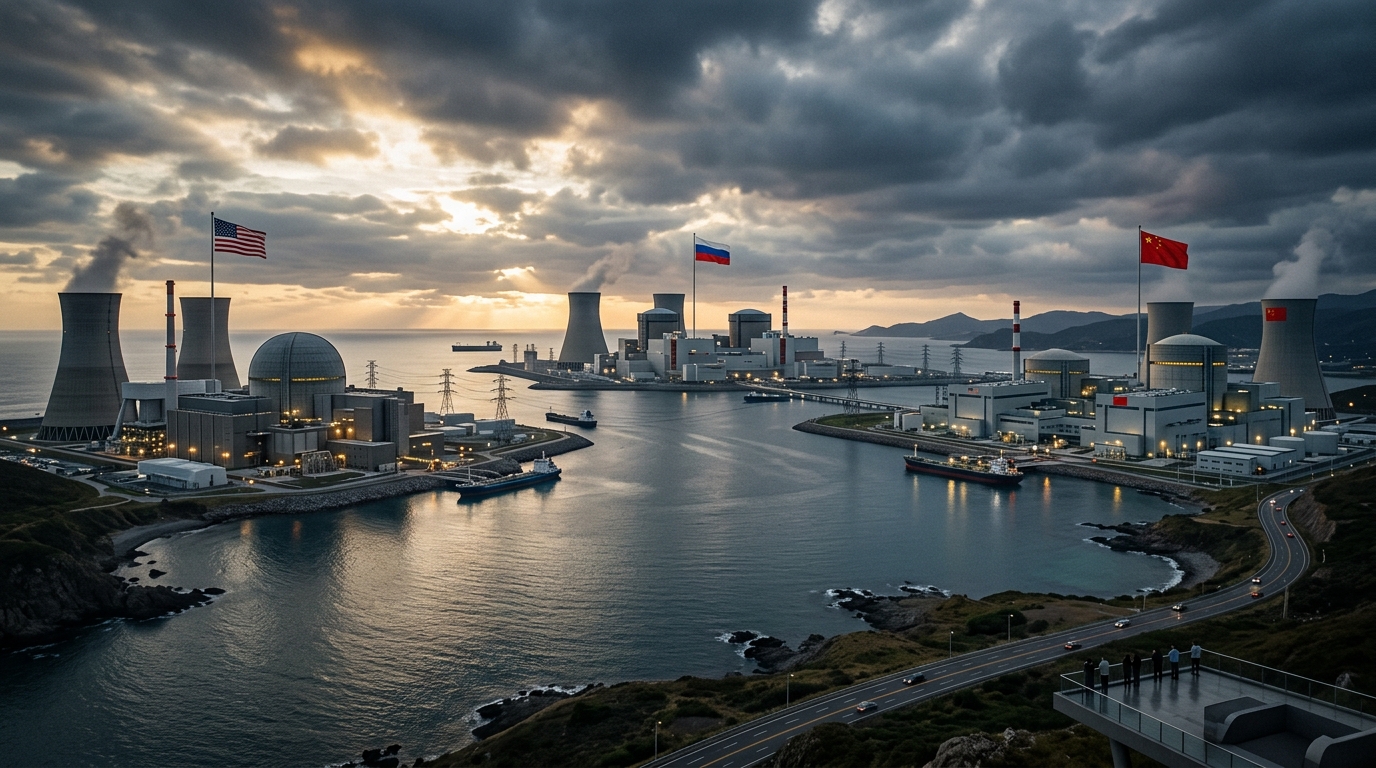
In a move that could fundamentally redefine modern geopolitics, US President Donald Trump confirmed that Washington is actively holding discussions with Moscow and Beijing aimed at the eventual denuclearization of the world’s most powerful nuclear states.
The revelation, shared during a recent interview with Newsmax, marks a sharp strategic pivot toward tripartite arms control. It comes at a critical historical juncture, arriving just months after the landmark Strategic Arms Reduction Treaty (New START) expired in early 2026 without a formal replacement.
Breaking the Diplomatic Silence
Speaking on the reality of global arsenals, Trump expressed a strong desire to de-escalate the modern arms race. “The whole thing is a shame, because I'd love to denuclearize if possible,” Trump stated. He further clarified that active dialogues are underway, confirming, “we're actually talking to Russia about that, and we're talking to China about that denuclearization.”
Reports indicate that these efforts include direct communication between Trump and Chinese President Xi Jinping. For decades, international nuclear frameworks have operated primarily on a bilateral axis between the United States and Russia. By formally drawing China into the core of these security negotiations, the current administration is addressing a long-standing gap in international defense policy.
The Changing Global Balance of Power
According to data compiled by the Stockholm International Peace Research Institute (SIPRI), Russia currently holds the world's largest overall stockpile of stored nuclear warheads, closely followed by the United States, with China maintaining the third-largest arsenal. However, the dynamics of deployment tell a more nuanced story: the United States currently outpaces Russia in the exact number of active, deployed warheads.
A primary catalyst for Washington's renewed urgency is Beijing’s rapidly advancing military infrastructure. During his remarks, Trump projected that China is on an aggressive trajectory to "catch up" with US nuclear capabilities within the next five years. This rapid modernization has convinced policymakers that any future arms control framework is functionally obsolete unless it binds Beijing to the same legal limitations as Washington and Moscow.
Life After the New START Treaty
The expiration of the New START treaty earlier this year effectively removed the final remaining regulatory guardrails on the world's primary nuclear programs. Originally signed in 2010 by former US President Barack Obama and Russian President Dmitry Medvedev, the treaty placed strict caps on deployed strategic warheads and instituted rigorous on-site verification inspections.
While a five-year extension was mutually agreed upon in 2021, its expiration left a dangerous legal vacuum. Because a formal renewal was not achieved, any continuation of these security caps now relies entirely on voluntary executive decisions by the respective heads of state rather than structured international law.
Obstacles to a Tripartite Framework
While the administration's stated goals introduce a wave of diplomatic optimism, geopolitical analysts urge caution. Forging a three-way agreement presents distinct hurdles:
- Asymmetric Arsenals: China has historically resisted joining Western arms treaties, arguing that its stockpile is purely defensive and significantly smaller than the massive Cold War-era inventories maintained by the US and Russia.
- Geopolitical Friction: Ongoing trade disputes, technological competition, and regional security concerns in Eastern Europe and the Indo-Pacific introduce deep-seated mistrust into the negotiation room.
- Verification Protocols: Creating a new, transparent inspection system that satisfies the security requirements of Washington, Moscow, and Beijing simultaneously will require years of complex bureaucratic and military calibration.
A Vision for Economic and Military De-escalation
Beyond the reduction of immediate security threats, the administration has framed these denuclearization talks as a pathway toward mutual fiscal relief. The financial burden of maintaining, modernizing, and securing thousands of legacy nuclear warheads costs global superpowers hundreds of billions of dollars annually.
By steering the conversation toward a managed reduction of stockpiles, Washington hopes to disincentivize the continuous production of next-generation weapons systems. If successful, this tripartite dialogue could shift global focus away from existential military posturing and toward long-term macroeconomic stability.