
The Moroccan government has set its sights on securing fresh domestic financing to fuel its strategic economic ambitions. On October 13, 2026, the Direction du Trésor et des Finances Extérieures (DTFE), an arm of the Ministry of Economy and Finance, officially announced a new treasury bond issuance via competitive tender. While local primary dealers coordinate directly with the central bank, Bank Al-Maghrib, the operation serves as a fundamental cog in Morocco's macroeconomic machinery.
This specific auction targets multiple financial horizons, balancing short-term liquidity needs with long-term capital stability. For everyday observers, these moves offer a rare glimpse into how the country balances its checkbook, finances infrastructure, and controls the broader cost of national debt.
The Blueprint of the October Auction
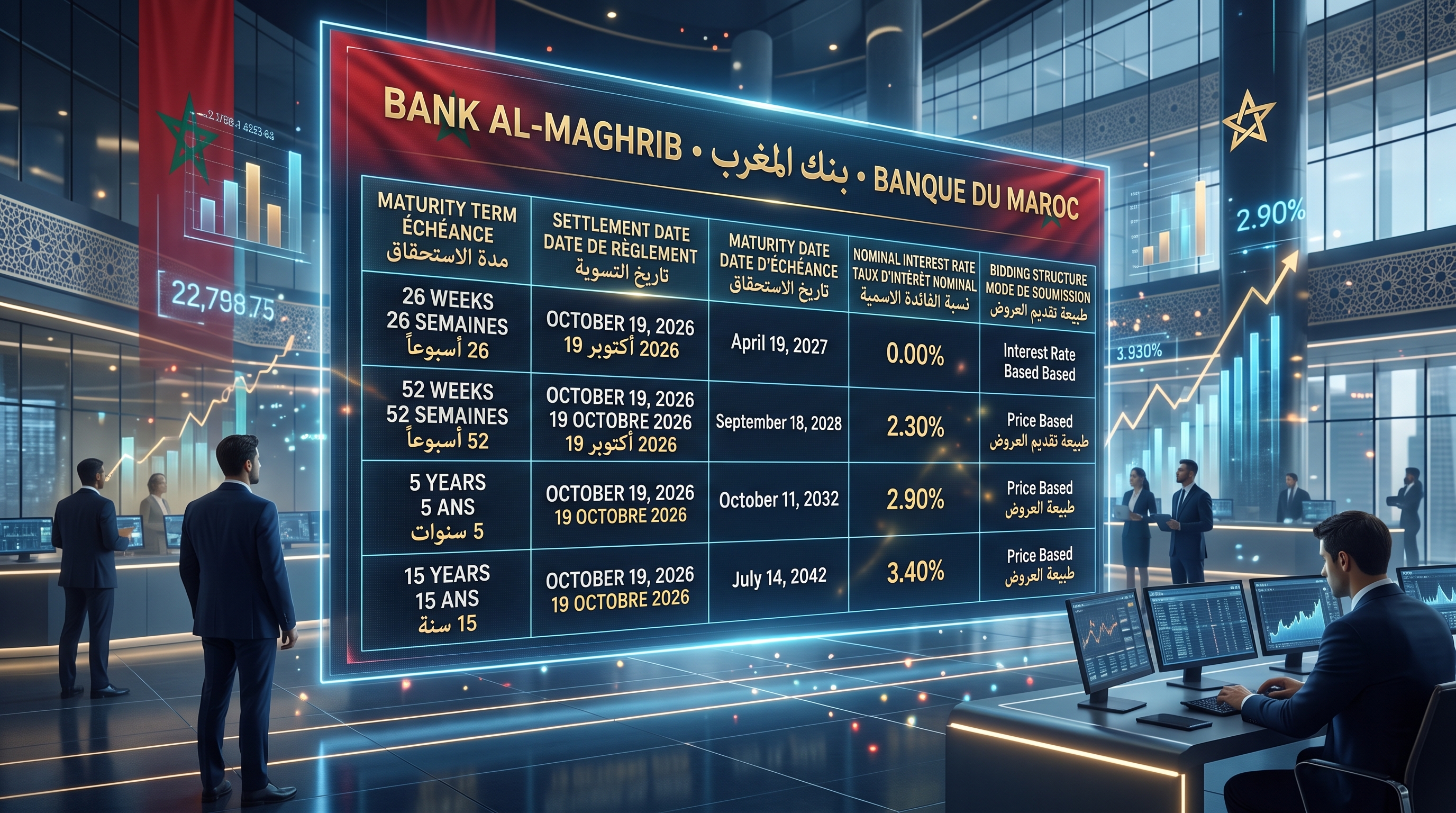
The official state circular reveals a highly structured approach to this debt issuance. The subscription window opened swiftly at 08:30 and closed at 11:00 on October 13, 2026, with the official settlement date finalized for October 19, 2026.
To cater to varying investor appetites, the Treasury split the auction across four distinct maturities, allowing them to balance immediate cash flow with prolonged obligations:
| Maturity Date | Interest Rate | Structure |
|---|---|---|
| 19-04-2027 | 0.00% | Interest |
| 18-09-2028 | 2.30% | Price |
| 11-10-2032 | 2.90% | Price |
| 14-07-2042 | 3.40% | Price |
A crucial operational distinction lies in how investors submit their offers. For the shorter 26-week bills, the Treasury accepts bids structured strictly around the desired interest rate. For the 52-week, 5-year, and long-term 15-year bonds, bids are evaluated based on the purchasing price. Furthermore, authorized primary dealers are granted the privilege to submit Non-Competitive Bids under the specific guidelines mandated by the Bank Al-Maghrib circular.
Why This Auction Matters for the Economy
When a country issues treasury bonds, it is essentially asking institutional investors—like local banks, insurance firms, and pension funds—for a loan. The rates fixed by the Ministry of Economy and Finance tell a compelling story about Morocco's current financial health.
A 15-year commitment at a 3.40% nominal rate signals that the state intends to lock in stable, long-term financing costs. This cautious local approach aligns with Morocco’s overall goal under its 2026 Fiscal Framework, which aims to compress the national budget deficit down to a manageable 3% of Gross Domestic Product (GDP). By sourcing a healthy mixture of local currency from domestic tenders alongside strategic international fundings, the Treasury prevents the domestic banking market from drying up while keeping inflation in check.
Balancing the Scale: Internal vs. External Debt
Historically, the Treasury has carefully managed the equilibrium between internal borrowing and international debt. Earlier in the cycle, successfully pulling off a substantial international Eurobond issue helped lift pressure from domestic banks. Tapping local markets via this October auction ensures the country maintains direct, reliable lines of credit with domestic institutions.
For the average citizen, these massive financial maneuvers might feel distant, but they directly dictate daily economic realities. Stable, successfully subscribed bond auctions mean the state can comfortably fund massive social protection upgrades, inject capital into public infrastructure, and maintain currency stability without being forced to implement abrupt fiscal changes or consumer tax hikes.
By maintaining a clear, transparent schedule of diverse bond maturities, Morocco continues to demonstrate to local and global watchers alike that its financial ship is being steered with a steady, calculated hand.
Click here for the official publication by Bank Al-Maghrib