This comprehensive report provides an in-depth analysis of Morocco’s current macroeconomic landscape, highlighting a remarkable period of stabilization, resilience, and strategic growth. Following the global economic turbulence and inflationary pressures of recent years, Morocco has successfully steered its economy toward a highly favorable trajectory for the coming years.
As detailed in the following sections, the nation’s economic outlook is defined by four key pillars: strictly controlled inflation that has cooled significantly since its 2022 peaks, and a steady, reliable expansion of non-agricultural sectors that ensures a more diversified economy. Furthermore, a sharp acceleration in bank credit is providing businesses with vital access to capital, while the government's steadfast commitment to fiscal discipline has resulted in shrinking deficits and record-high foreign currency reserves. Together, these indicators paint a promising picture of a robust Moroccan economy, well-equipped to navigate global shocks and sustain long-term prosperity.
1. Inflation Stays Under Control
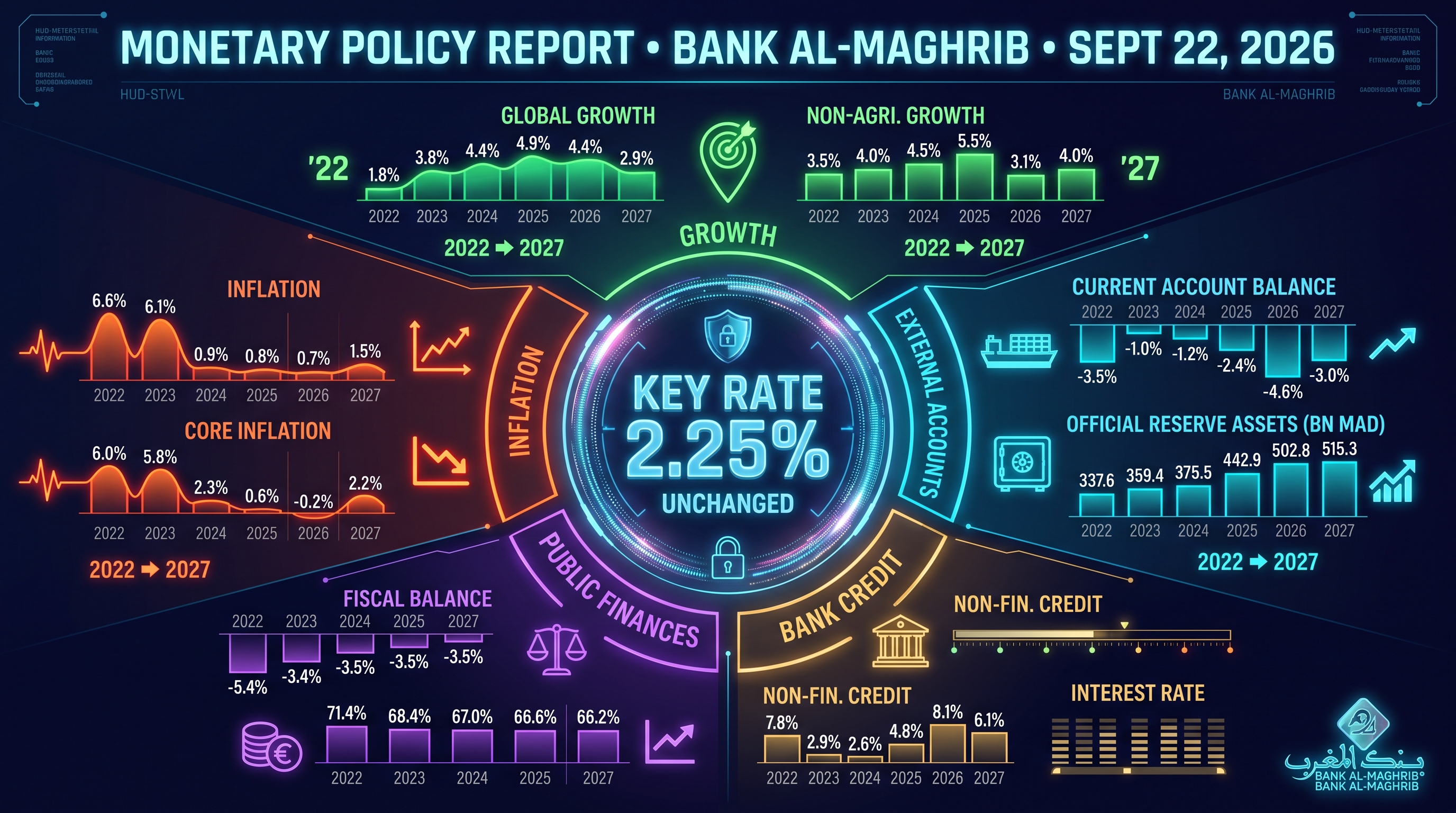
Morocco’s inflation rates have dramatically cooled down since the peaks of 2022 and 2023.
- Overall Inflation: After hitting 6.6% in 2022, inflation fell to 0.9% in 2024. It is projected to remain low at 0.8% in 2025 and 0.7% in 2026, before a slight rise to 1.5% in 2027.
- Core Inflation: Excluding volatile goods, core inflation follows a similar downward trend, dropping from 6.0% in 2022 to 0.6% in 2025, with a minor dip to -0.2% in 2026 before recovering to 2.2% in 2027.
2. Steady Growth Beyond Agriculture
The central bank reports a consolidation of non-agricultural economic growth, ensuring the economy relies on more stable industrial and service sectors.
- Global Growth: Morocco’s overall economic growth is projected at 4.4% for 2026, normalizing to 2.9% in 2027.
- Non-Agricultural Sector: This sector maintains a steady path, forecasted to grow by 3.1% in 2026 and pick up to 4.0% in 2027.
3. Bank Credit and Financing
Financing for the non-financial sector is experiencing a significant boost, making it easier for businesses to access capital.
- Credit Expansion: Credit to the non-financial sector is seeing a sharp acceleration, expected to peak at an 8.1% change in 2026 before adjusting to 6.1% in 2027.
- Interest Rates: Average lending rates for the non-financial sector remain relatively stable, floating around 4.66% (expected over the next 18 months) and 4.81% (expected over the next 31 months).
4. Public Finances and External Accounts
Morocco is working toward stabilizing its national debt and fiscal deficits over the medium term.
- Fiscal Deficit: The budget deficit as a percentage of GDP is gradually shrinking, improving from -5.4% in 2022 to -3.4% in 2026, showing clear signs of fiscal discipline.
- Treasury Debt: Total government debt is projected to successfully stabilize down to 66.1% of GDP in 2026.
• • Official Reserve Assets: The country's foreign currency reserves continue to strengthen significantly, rising to an estimated 502.8 billion MAD in 2026 and hitting 515.3 billion MAD by 2027, providing a robust safety net against global economic shocks
Click Here For The Official Publication Published By Bank Al Maghrib