
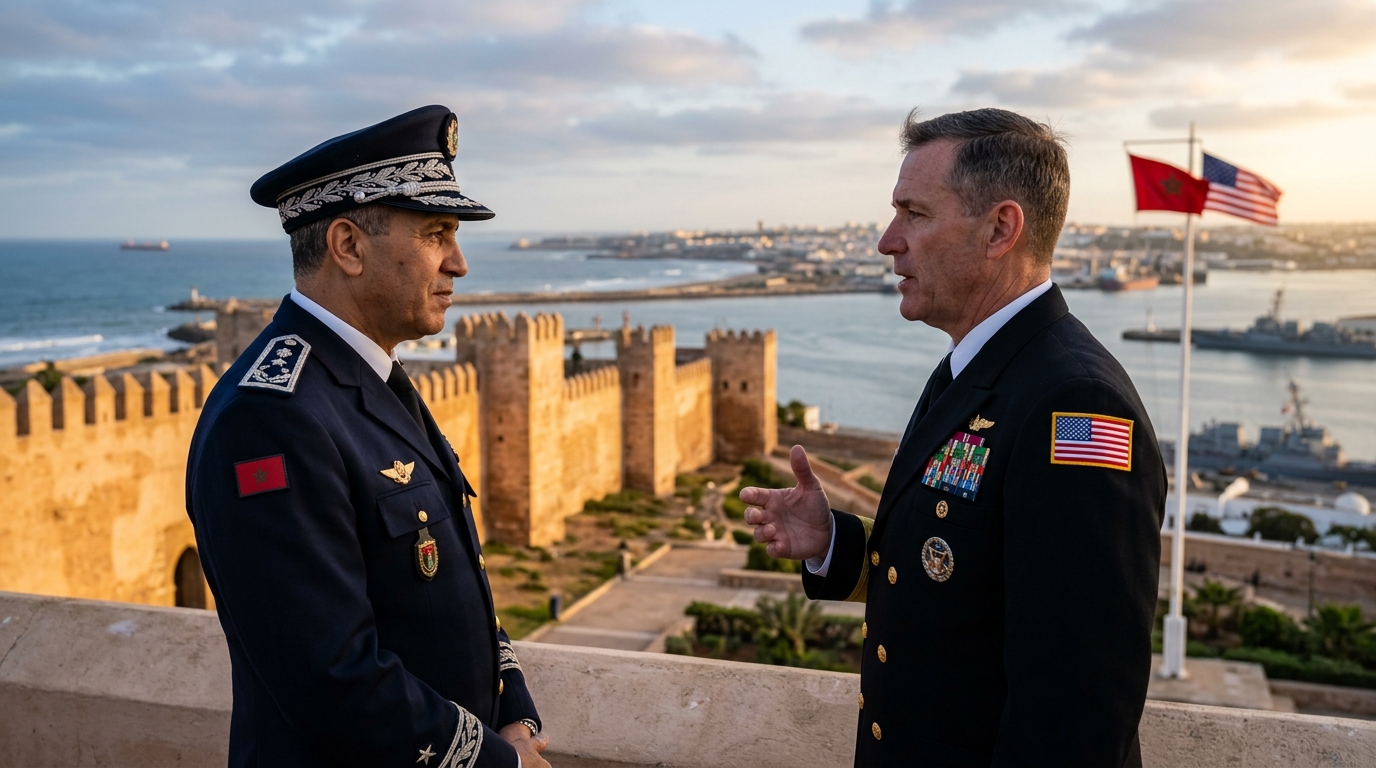
When looking at the complex web of global diplomacy, observers often focus heavily on Washington’s ties with Eurozone giants or Pacific powerhouses. Yet, one of the most vital pillars of American foreign policy rests quietly at the northwest edge of Africa.
The relationship between the United States and the Kingdom of Morocco is not a modern marriage of convenience. It is a profound, deeply rooted alliance shaped by unique geography, shared global security goals, and a historic friendship that predates the ratification of the U.S. Constitution.
To understand why Morocco remains so indispensable to America, we must look at where it sits on the map, how it stepped up when the U.S. was a vulnerable young nation, and how it continues to act as a stabilizing bridge in an unpredictable world.
The Power of Geography: America’s Atlantic Gateway
Geography dictates destiny, and Morocco’s location gives it immense geopolitical value. Positioned at the absolute northwestern tip of the African continent, Morocco stands as the dual gateway to both the Atlantic Ocean and the Mediterranean Sea.
For the United States, a maritime nation whose global economic dominance relies on secure shipping lanes, Morocco is a critical focal point.
- The Gibraltar Chokepoint: Morocco looks directly across the narrow Strait of Gibraltar toward Spain. This tiny 14-kilometer stretch of water is the only entry point into the Mediterranean from the Atlantic. Millions of barrels of oil and billions of dollars in commercial cargo pass through this corridor daily.
- The Pivot to Africa: As American enterprises and defense strategies look toward Africa's fast-growing markets, Morocco serves as the ideal regional hub. Its world-class infrastructure—such as the massive Tanger Med Port—bridges the gap between American naval power, European trade, and African logistics.
For U.S. defense strategists, a stable, pro-Western Morocco ensures that this vital marine gateway remains open and safe from hostile actors.
A Friendship Born in 1777: America's First Friend
While many Americans view France as their oldest revolutionary ally, it was actually the Kingdom of Morocco that first recognized the independence of the United States.
In December 1777, while George Washington’s forces were struggling through the brutal winter at Valley Forge, Sultan Mohammed III issued a royal decree. He declared that American merchant ships would be granted free entry into Moroccan ports, allowing them to trade and enjoy safe passage under the protection of the Moroccan Sultanate.
This bold diplomatic move was the first time a foreign head of state publicly acknowledged the sovereignty of the United States.
This early gesture culminated in the 1786 Treaty of Marrakech (also known as the Moroccan-American Treaty of Peace and Friendship). Signed by American founding fathers Thomas Jefferson and John Adams, this document holds a remarkable distinction: it is the longest unbroken treaty relationship in United States history.
Separation of Myth and History: The Moors and the U.S. Dollar
When exploring the deep history between America and the Arab-Berber worlds, observers frequently encounter a fascinating piece of cultural folklore: the idea that the "Moors" are explicitly honored or coded on the U.S. one-dollar bill.
As a professional news publication, it is vital to separate cultural myth from historical fact:
| The Popular Myth | The Historical Fact |
|---|---|
| The eye atop the pyramid or certain geometric stars on the U.S. dollar bill are secret nods to the Moors or the Moroccan Sultan who helped the young republic. | The imagery on the dollar bill comes from the Great Seal of the United States, designed by the Continental Congress to symbolize strength, duration, and divine providence. There is no historical evidence linking its design to North African architecture or Moorish treaties. |
While the dollar bill myth is simply folklore, the actual history of Moorish and North African influence in early America is very real. During the founding era, the term "Moor" was widely used by Westerners to describe the Islamic inhabitants of North Africa. The young American republic was fascinated by the style, architecture, and horse-breeding traditions of the region. In fact, early American diplomatic records are filled with deep admiration for the sophisticated Moroccan diplomats who visited the U.S., cementing a shared respect that long outlived the physical currencies of the era.
The Modern Anchor: Security, Trade, and Stability
Today, the geopolitical partnership between Washington and Rabat is stronger than ever. Morocco is officially designated as a Major Non-NATO Ally of the United States, highlighting its irreplaceable role in global security.
- Counter-Terrorism and Intelligence: In an often volatile region, Morocco stands out as a sanctuary of stability. The Kingdom works closely with U.S. intelligence agencies to track security threats across the Sahara and the Sahel, acting as a vital shield against extremism.
- African Lion Exercises: Every year, Morocco hosts African Lion, the U.S. military’s largest and most complex joint defense training exercise on the African continent. This massive operation coordinates thousands of troops from dozens of countries to ensure regional defense readiness.
- The Economic Catalyst: Morocco is the only nation on the African continent to share a formal Free Trade Agreement (FTA) with the United States. This economic pact has allowed billions of dollars in aerospace, automotive, and agricultural trade to flow seamlessly between the two nations.
Summary: An Unshakable Foundation
The alliance between America and Morocco is built on a rare combination of geographical advantage, historic loyalty, and shared strategic goals. From the historic moment in 1777 when a Moroccan Sultan stood up for a struggling new democracy, to the modern counter-terrorism operations keeping global trade routes safe, Morocco has proven to be far more than just a regional partner. For the United States, the Kingdom remains a vital gatekeeper, a historic ally, and an indispensable bridge to the future.